
Lubbock County Booking Search Formats
The Lubbock County Sheriff's Office publishes current jail data in three official formats. The interactive jail view supports an on-screen lookup. A read-only PDF roster suits a quick scan, while the downloadable Excel file helps sort the same operational list. The county calls the roster real-time and warns that it may not be fully accurate or complete. Confirmed search identifiers are name, booking number, and Sheriff's Office number. There is no login or fee.
The official Lubbock County jail-roster page shows the available formats in the captured source below.

The roster image helps a reader choose a format, but every Lubbock County booking result remains a custody record rather than a finding of guilt.
Lubbock County Arrest History
Lubbock County arrest records can begin with many custodians. The Lubbock County Sheriff's Office makes arrests and manages detention records. Lubbock Police, Wolfforth Police, Slaton Police, Idalou Police, Shallowater Police, Texas Tech Police, school-district police, constables, and Texas DPS can create the underlying report when their officers make the arrest. The county jail then creates its own booking and intake record after accepting the person.
An arrest history is not one universal file. It may include an agency report, jail card, fingerprint-linked state cycle, magistration and bond record, then a later prosecutor and clerk case. A charge can be refused, changed, dismissed, no-billed, deferred, or end in conviction. The current roster is only a snapshot. Its absence cannot prove that no past Lubbock County arrest occurred.
Lubbock County Arrest Record Flow
Each custodian answers a different question. The arresting agency documents the event and officer action. Lubbock County Detention Center records intake, identification, allegations, bond, custody, and release. Reportable adult bookings send fingerprints and transaction data into the Texas DPS Computerized Criminal History system. The prosecutor records whether to accept, reject, alter, or no-bill a charge. The clerk begins a court file only when a case is filed.
Record flow: Agency Report › Lubbock County Booking › Fingerprint Cycle › Magistration › Prosecutor Decision › Court Case
A lag or mismatch can occur at any handoff. Intake may still be underway. A prosecutor may not have filed a case. Names may differ, or a disposition may not yet have reached DPS. Save the booking or SO number because it is the best local bridge between the roster, records office, and later court work.
Looking Up Lubbock County Arrests
A complete lookup uses the live custody source first, then moves to the agency report, clerk file, and state record. Phone and counter access remain important when the online result is blank. The formal request route is also needed for jail material that the public roster does not show.
- Search the official interactive roster, PDF, or Excel file by name, booking number, or SO number. If intake may be in progress, call the jail desk at 806-775-7009 or 806-775-7048.
- Identify the arresting agency. Ask LCSO for its record through LSO-1064, use the Lubbock Police report or GovQA channels for LPD, or contact the other city, campus, school, constable, or state agency that created it.
- Check Lubbock County criminal court cases for a filed felony or Class A or B misdemeanor. A booking may appear before a prosecutor files anything.
- Use the Texas DPS Public Criminal History Conviction Search for the separate statewide public conviction and deferred-adjudication product. A fingerprint personal review is the fuller identity-matched route for one's own Texas history.
- Submit the formal records request or visit the correct counter when a roster, report portal, or court index cannot supply the needed Lubbock County arrest record.
Note: A blank Lubbock County roster result can reflect intake timing, release, a name mismatch, or the roster's limited custody window.
Lubbock County Sheriff Arrest Requests
The Sheriff's revised LSO-1064 form accepts in-person, mail, and email receipt, though the form does not print a destination. Confirm the delivery route through 806-775-1400 before sending it. The request asks for the subject's name, date of birth, booking, SO, or case number when known, a date range, and a description. A requester can choose email, mail, or in-person pickup for the response.
The form includes checkboxes for arrest reports, booking and intake, incident reports and jail logs, release or transfer, transport, surveillance, body-camera video, in-car video, radio or interview audio, and other categories. Medical and mental-health records carry added authorization and confidentiality limits. A requester can agree to applicable charges or ask for a written estimate first. Texas law requires an estimate above $40, but the form gives no fixed fee.
Lubbock County Sheriff's Office
712 Broadway
Lubbock, TX
806-775-1400
Monday-Friday, 8 a.m.-5 p.m.
Detention Records and Jail Desk
3502 N Holly Avenue
Lubbock, TX
806-775-7009 or 806-775-7048
Call to confirm the right records channel
A person may obtain their own jail card through Detention Records. Another person's card requires the open-records process. Confidential, juvenile, health, victim, active-investigation, and detention-security material may be withheld or redacted under the authorities listed on LSO-1064.
Inside a Lubbock County Arrest Record
A Lubbock County booking entry records intake, not the full police narrative or final court result. The public roster confirms only a limited set of search identifiers and bond status. Interactive inspection was blocked during research, so unverified demographic or charge columns are not claimed. For a full incident narrative, request the arresting agency's report. For the final charge and outcome, inspect the clerk's case file.
| Name | Helps locate the custody entry; verify spellings and aliases through the source agency. |
|---|---|
| Booking Number | Identifies the jail intake event and helps link a records request. |
| SO Number | The Sheriff's Office identifier confirmed as a roster search key. |
| Arresting Agency | Points to the office that holds the incident or arrest report. |
| Alleged Charge | States the intake allegation, which can differ from a charge later filed in court. |
| Bond Status | Reflects bond information after magistration and may change. |
| Release or Custody Status | Describes jail status at the time of the entry, not guilt. |
| Booking Photo | The official roster does not promise a mugshot; any release request remains subject to Texas law and redaction. |
Use the confirmed fields as leads, not as a final verdict. A later Lubbock County clerk record can show that a filed charge or outcome differs from the first booking allegation.
Lubbock County Arrest Report Custodians
The jail does not become the owner of every police report just because a person was booked there. Route the request to the agency whose officer created the report. LCSO uses LSO-1064. Lubbock Police offers an official report search for eligible reports and a GovQA request fallback. Its portal needs the two-digit filing year and the remaining seven case-number digits with leading zeroes.
| Arrest source | Official request route | Record sought |
|---|---|---|
| Lubbock County Sheriff | LSO-1064 or 806-775-1400 | Sheriff arrest, incident, and jail records |
| Lubbock Police | LPD Report Search, GovQA, or open-records staff | LPD report and releasable event details |
| Idalou or Shallowater Police | Contact the city police or city records custodian | Report created by that city's officer |
| Wolfforth or Slaton Police | Contact the issuing city department | City arrest or incident report |
| Campus, school, constable, or DPS | Request from the named arresting agency | Agency report, subject to its lawful limits |
LPD also accepts requests through GovQA, orr@mylubbock.us, mail to PO Box 2000 marked for the Open Records Officer, and the Citizen's Tower counter at 1314 Avenue K, floor 11. The open-records number is 806-775-2226. Sexually oriented cases, juvenile complainants, witness or suspect details, evidence, and active-investigation material can face access limits.
Booking Logs and Recent Arrests
The Lubbock County roster is a current operational tool. The county labels the web roster real-time, and the Lubbock County Sheriff's App advertises a jail search refreshed at half-hour intervals. Those labels are not identical. Use the web roster for the current official view, then use the app as a mobile route to jail search, bonding information, alerts, visitation, and other detention services.
A recent booking may not display at once because intake is still underway. Call 806-775-7009 or 806-775-7048 if the timing suggests a new admission. Bond data may also wait for magistration. Initial appearances occur at least twice each day and up to three times as needed. Streams are not archived, and recording is prohibited.
Entries can leave a live roster after release. A current list is therefore not a complete history. Save the booking or SO number, request the jail card when needed, and check the right clerk after a filing. Do not treat a missing entry as a clean-record statement.
Lubbock County Jail Versus TDCJ
Lubbock County Detention Center covers local jail custody, including many people awaiting court action. The Texas Department of Criminal Justice locator covers people received into state corrections after a prison sentence. These databases are not substitutes. Once a person transfers, the state locator can show state identifiers, unit information, and projected release or parole dates that a county booking log was not built to provide.
The official TDCJ Online Inmate Search appears in the captured source below.
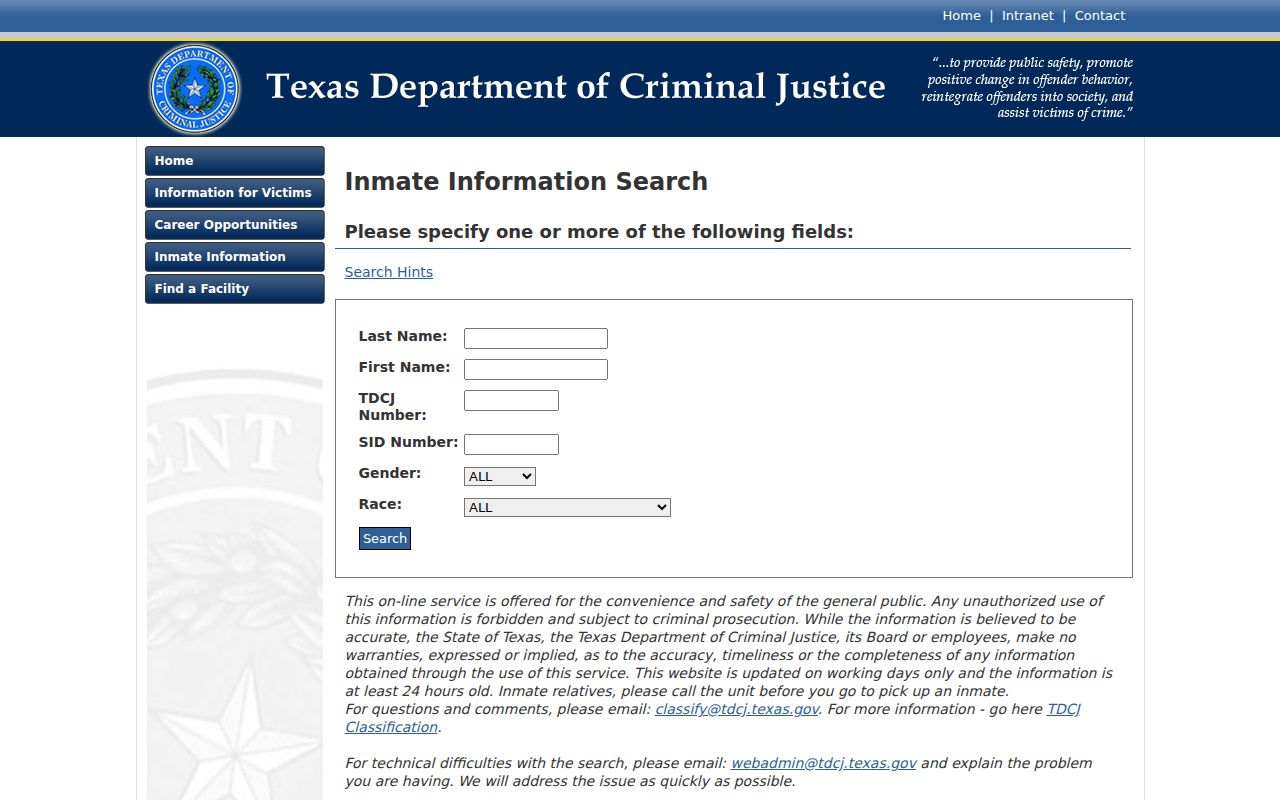
The state-search image marks the custody handoff after sentencing, while recent Lubbock County arrest and booking facts remain with local agencies.
Phone and notification channels supplement both systems. The jail desk can address local custody. TDCJ's inmate-information channels address state custody, and Texas victim-notification services can provide confidential updates. A state-prison result still does not replace the Lubbock County court judgment that imposed the sentence.
Arrests Are Not Convictions
An arrest record proves that an agency took a person into custody or reported an arrest event. It does not prove that prosecutors filed the same allegation or that a court found guilt. A conviction appears after a legally recognized finding and judgment. Lubbock County arrest records and court records must therefore be read side by side, with each source kept in its proper role.
| Point | Arrest record | Conviction record |
|---|---|---|
| Created by | Arresting agency and Lubbock County jail | Court, clerk, and later state reporting |
| Shows | An arrest, allegation, booking, bond, or release | A judgment and the court's recorded outcome |
| Found at | Agency report, jail card, and roster | Clerk case file and public DPS conviction product |
| Possible result | Release, no charge, changed charge, or later case | Conviction, acquittal, dismissal, deferred result, or appeal |
Note: A Lubbock County arrest is not proof of guilt, and many bookings do not end in the charge first alleged.
Lubbock County Dismissed Arrest Records
A dismissal does not automatically erase every arrest record. Texas now places expunction law in Code of Criminal Procedure Chapter 55A, effective January 1, 2025. Possible routes can include acquittal, pardon, qualifying no-charge or no-bill outcomes, mistake or fraud dismissals, and some successful pretrial-diversion cases. Eligibility depends on the facts, the criminal episode, later charges, supervision, and statutory time rules.
For a Lubbock County filing, the District Clerk expunction desk is at 904 Broadway and uses 806-775-1373. The current local fee and complete form fields were not available in the research, so call rather than guess. After an order, compare the county index with a DPS fingerprint personal review. If a government source still shows the record, use a certified order with the reporting agency and the DPS correction channel.
Restricted records: Chapter 55A governs Texas expunction, while nondisclosure restricts ordinary public release without the same broad destruction effect.