
Sex Offender Checks in Lubbock County
The official starting point is the Texas Public Sex Offender Registry. The Texas Department of Public Safety Crime Records Division maintains that statewide system. It supports a county filter, so a reader can focus on Lubbock County without treating a Lubbock city boundary as the edge of the search. Name, city, ZIP, address, and map modes answer different Lubbock County questions. A Lubbock County name search helps confirm a known person. A Lubbock County map or place search supports awareness near a home, school route, or other familiar point.
The Lubbock County registry is free to search. Public subscriptions and data downloads require a CRD Public Website account, while an ordinary Lubbock County search does not require paid credits. Lubbock County results should be checked against the listed name, aliases, photo, birth information, physical traits, address status, registering agency, and update date. Similar names alone are weak proof. Lubbock County residents should also note which local authority maintains the registration because the correct Lubbock County office changes across city and county lines.
How to Search the Texas Public Sex Offender Registry
DPS provides several paths into the same Lubbock County public registry. Start with the least broad set of Lubbock County facts that answers the question, then widen the Lubbock County search if needed. The official Texas registry search form shows how DPS organizes Lubbock County name, county, ZIP, address, and map controls.
- Open the official DPS registry and review its conditions for a Lubbock County search.
- Choose a mode. Enter a last name, select Lubbock County, or supply the Lubbock city, ZIP, or address needed for a place search.
- Use current-only or primary-address controls when those Lubbock County limits fit the question. Do not guess an unverified radius value.
- Open a likely Lubbock County profile and compare identity, address, offense, agency, and update fields before drawing a conclusion.
| Field Label | Type | Required | Notes |
|---|---|---|---|
| Last, First, Middle Name | Text | Last name in name mode | First and middle narrow the result. |
| City | Text | City mode | Use Lubbock, Wolfforth, Slaton, or another Texas city. |
| County | Dropdown | County mode | Select Lubbock from all Texas counties. |
| ZIP | Text | ZIP mode | Enter five digits. |
| Street or Address | Text | Location search | Pairs with the location or map view. |
| Primary Only or Current Only | Checkbox | No | Narrows address or result status. |
The captured registry image comes from the same DPS public search used for Lubbock County lookups.
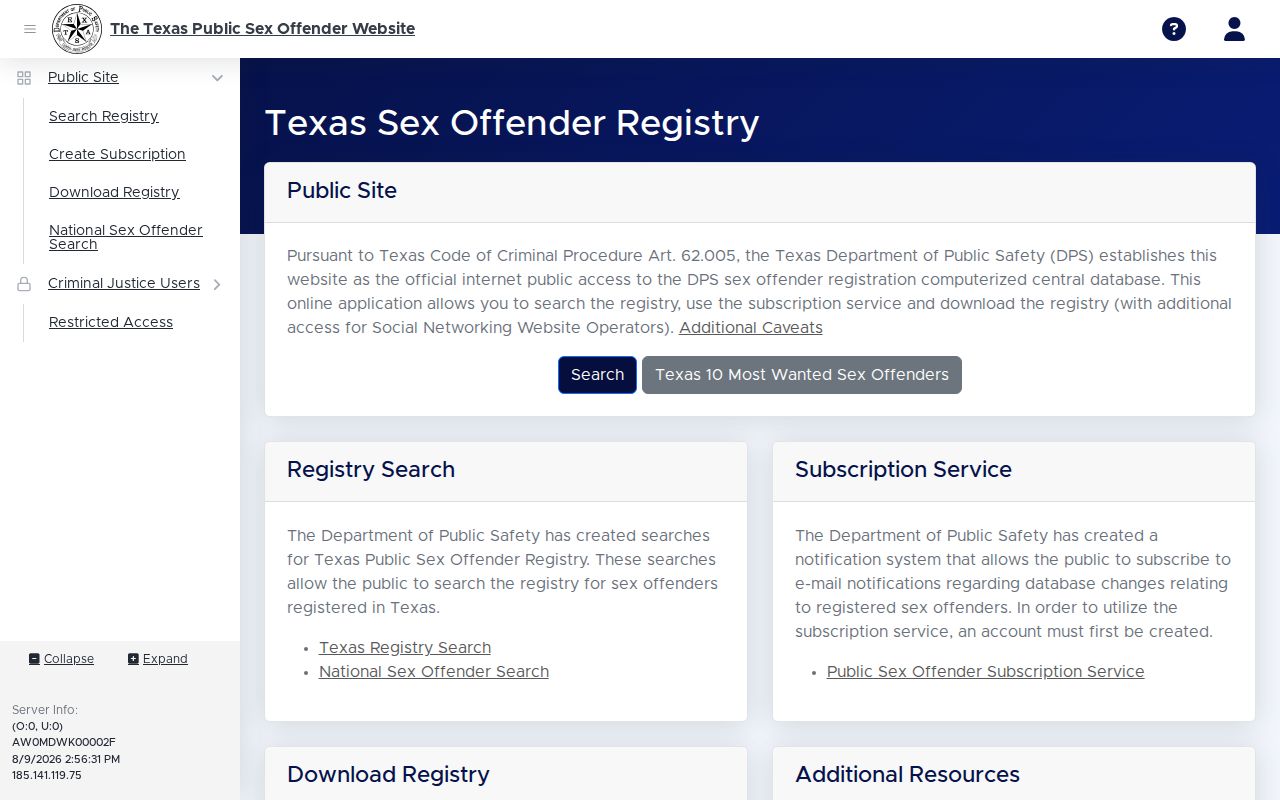
Its separate search modes are a useful reminder that a county search and an address search have different reach.
Lubbock County Registry Profile Limits
A Lubbock County public profile is detailed, but it is not an unrestricted file. Texas Code of Criminal Procedure Article 62.005 keeps Social Security numbers, driver-license numbers, phone numbers, online identifiers, employer data, victim-identifying facts, certain DPS-added information, and juvenile information ordered nonpublic out of the Lubbock County public view. Missing Lubbock County data can therefore reflect a lawful limit. It does not always mean the local Lubbock County authority failed to collect the fact.
Vehicle information is another Lubbock County search trap. Texas collects and publishes it only in specified trafficking circumstances, so readers should not expect a vehicle row on every Lubbock County profile. Lubbock County address entries also need context. A residence, higher-education affiliation, registering agency, and Lubbock County profile update date can each describe a different aspect of current duties. When something appears stale, report the Lubbock County concern instead of trying to investigate a registrant in person.
Inside a Registry Profile
Lubbock County DPS profiles join identity, location, offense, and registration data. Each Lubbock County field group answers a distinct question. The photo and physical description help distinguish similar Lubbock names. The Lubbock County agency and update date show who last handled the registration. Offense and court facts describe the event that produced a Lubbock County registration duty, while duration and status describe that duty today. No Lubbock County row should be read alone.
| Name and Aliases | Current name plus alternate names reported to the registry. |
|---|---|
| Photo and Description | Current color photo when available, birth date, sex, race, height, weight, hair, eyes, shoe size, and reported marks. |
| Residence and Map | Public residence or geographic information, with higher-education affiliation where applicable. |
| Offense and Court | Statute, offense, victim-age category, adjudication date, court, county or state, and sentence information. |
| Risk and Duration | Texas numeric risk, registration term, and an end date or lifetime label when supplied. |
| Status and Agency | Compliance or registration status, registering agency, registry identifier, and last update information. |
The DPS registration program page supplies the legal and program context behind these public fields.
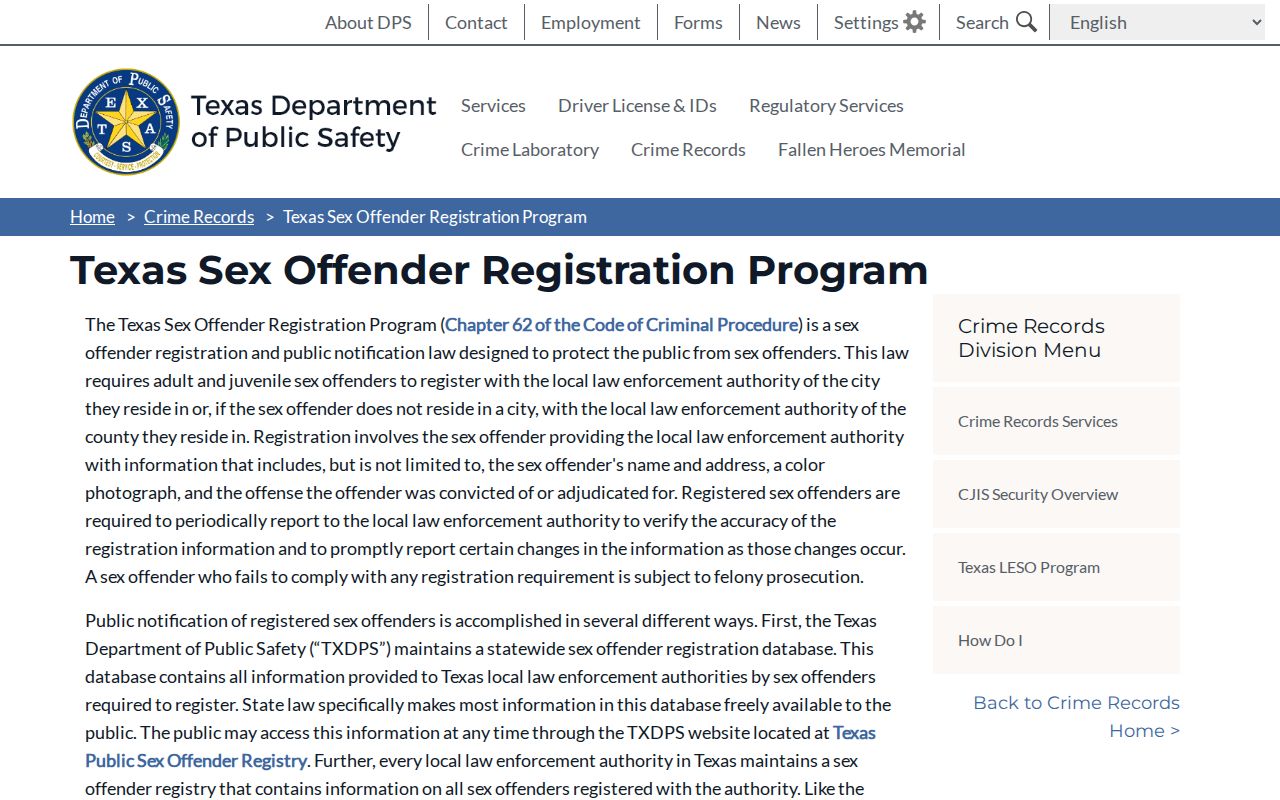
That program layer explains why a profile is a notice about a legal duty, not a live risk assessment or new accusation.
Lubbock County Registry Notification Distances
Texas uses targeted Lubbock County public notice for certain cases. DPS mails English and Spanish postcards for a civilly committed or high-risk Lubbock County person within one mile in an unsubdivided area or within three blocks in a subdivided area. Lubbock County authorities may also publish information about high-risk registrants. Lubbock County schools receive notices required by law through the local registration process. These rules explain why two Lubbock County households may receive different forms of notice even when both can use the same public registry.
Texas does not impose one blanket statewide residence-distance rule on all Lubbock County registrants. A Lubbock County person may face terms tied to supervision, and a Lubbock municipality may enact a controlled child-safety-zone ordinance. Those Lubbock County limits can differ in scope and duration. Do not infer that every Lubbock County registry marker violates a fixed distance from a school, park, or child-care site. Check the current order or Lubbock local code through the proper authority before treating the map as proof.
Texas Registration Levels and Requirements
Texas risk numbers on a Lubbock County profile are not federal SORNA tiers. Under Article 62.007, risk level 1 means low, level 2 means moderate, and level 3 means high risk of reoffense. Chapter 62 registration rules control Lubbock County public inclusion and reporting duties more broadly. Duration depends on the qualifying offense or adjudication, release, and end of supervision. Lubbock County verification frequency can depend on repeat or civil-commitment status rather than the risk number alone.
| Category | Duration | Verification |
|---|---|---|
| Listed adult sexually violent or repeat categories | Lifetime | Every 90 days for two or more sexually violent offenses |
| Other adult reportable conviction or adjudication | Through ten years after release or discharge from supervision, whichever is later | Generally annual near the birthday |
| Ordinary juvenile registration | Generally ten years after disposition ends or discharge | Depends on the governing order and category |
| Civilly committed sexually violent predator | Lifetime category | Every 30 days |
Name, online identifier, health, job, or education changes generally must be reported by day seven. Presence in another jurisdiction on three occasions in a month or for more than 48 straight hours can also trigger local reporting. Failure to comply is a felony.
Cross-State Lubbock County Registry Searches
A Texas-only Lubbock County result may not answer a search that crosses a state line. The U.S. Department of Justice operates the National Sex Offender Public Website, which federates public records from participating jurisdictions. Use it when a person recently moved from Lubbock, an address sits outside Texas, or a known history may come from another state. Then return to the contributing state registry for its full Lubbock County profile and terms.
The image below is sourced from the official National Sex Offender Public Website.
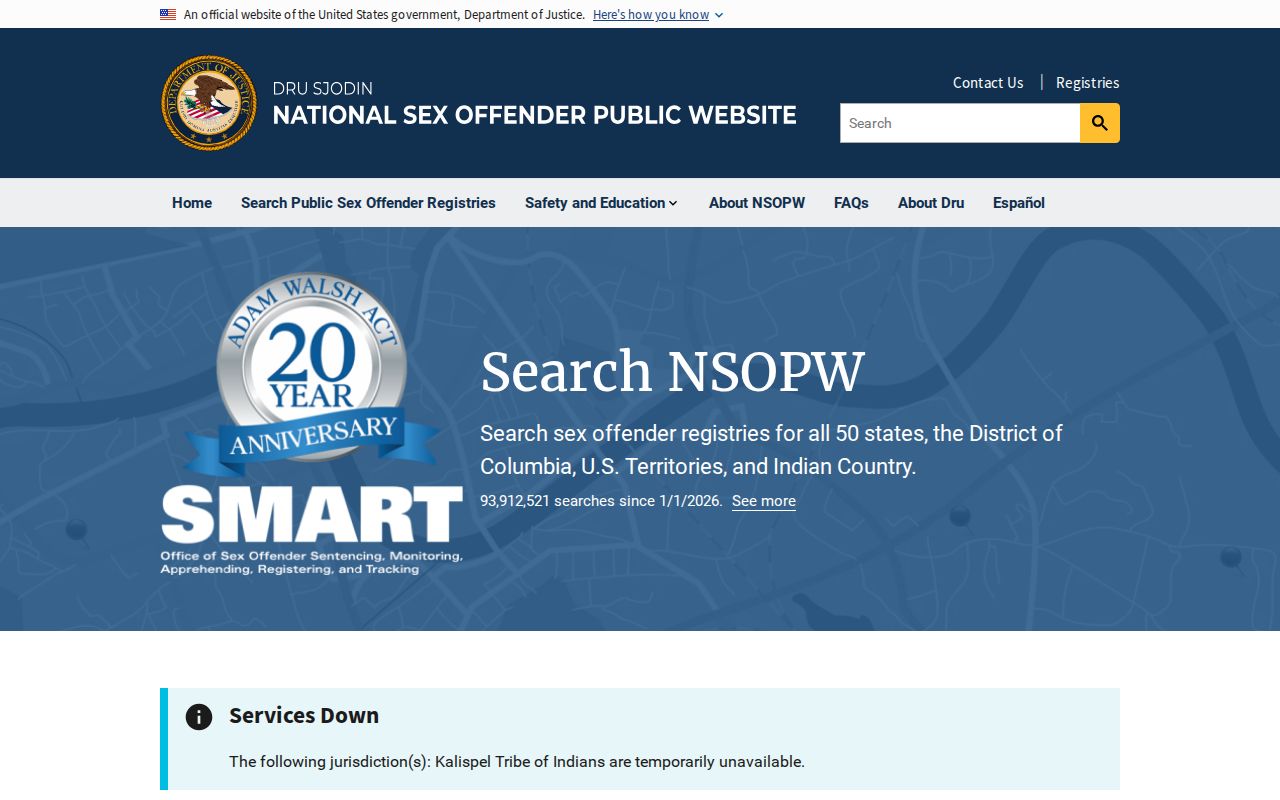
NSOPW adds geographic reach, while the Texas DPS profile remains the source for Texas-specific risk, agency, and registration details.
Search gaps can arise because public treatment differs among jurisdictions or an update is in progress. A national no-hit does not prove that no duty exists. Recheck spelling and aliases, inspect the relevant state system, and ask the listed authority about a concrete discrepancy.
Report Lubbock County Registration Gaps
Suspected Lubbock County noncompliance should go to the registering agency shown on the profile. Give the agency the public registry identifier, the displayed address or status, and the specific fact that appears inconsistent. LPD handles registrations inside Lubbock. LCSO handles the unincorporated county. Wolfforth and Slaton police handle their residents. This Lubbock County approach directs the report to the office with the registration file and avoids unsafe personal contact.
Registry records can lag a recent report or change. An agency can compare the concern with information that the public cannot see and decide whether follow-up is due. Do not publish a home address elsewhere or confront a person. For immediate danger, call 911. For a routine Lubbock County question, use the nonemergency contact for the registration authority.
Note: The registry describes a legal reporting status and past adjudication; it does not establish that a new offense has occurred.
Community Notification and Lawful Use
Public registry information serves awareness and safety planning. It may help a family review the area near a regular route, understand an official notice, or identify the agency responsible for a profile. It does not authorize surveillance, confrontation, threats, trespass, or punishment by private people. Match records with care, respect nonpublic victim information, and let law enforcement assess suspected breaches of a registration duty.
Misuse is a crime: Texas Penal Code §42.07 makes defined harassment a criminal offense. Registry access gives no right to harass, threaten, intimidate, trespass on, or harm a registrant or household.
DPS notices and local postcards should be read as official safety information, not proof of current dangerousness. If a Lubbock County profile seems wrong, preserve the public record details and call the listed agency. That step protects the reporting process and keeps community response within the law.