
Lubbock County Court Portal
Lubbock County Public Access is the official starting point for unrestricted District Clerk and County Clerk index material. A public user creates a free account, validates the email link within three days, and then uses the account to find general case details. The county confirms that the remote view includes case identifiers, parties, attorneys, and scheduling information. It does not promise document images. Exact buttons, date coverage, wildcard rules, and live field labels could not be verified, so a reader should not rely on guessed search controls.
The official Lubbock County Public Access portal is shown in the captured source below.
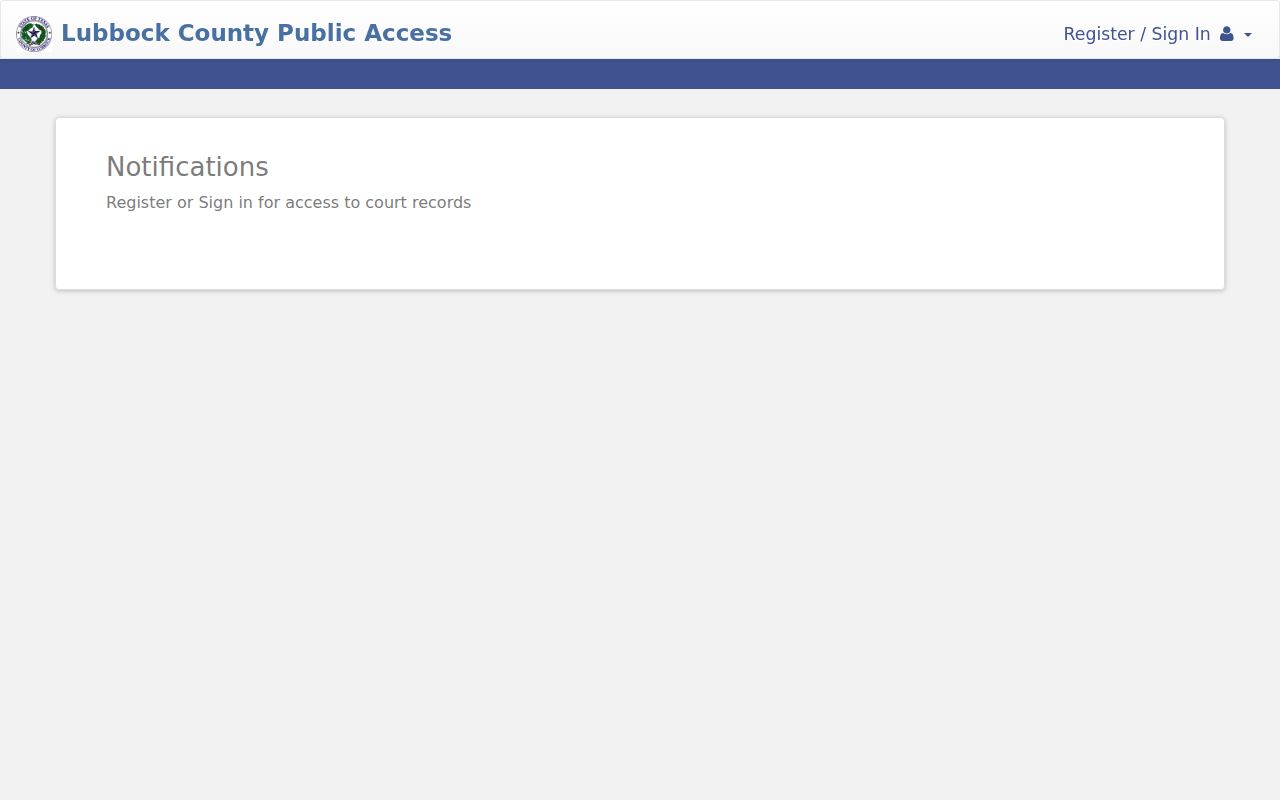
The portal image marks the remote index entrance, while the clerk remains the source for the filed Lubbock County court record.
re:SearchTX is Texas's statewide electronic filing and document-access system, but official Judicial Council material has historically excluded criminal case records from its broad public document collection. Lubbock County Public Access is the proper online route for local criminal cases.
Lubbock County Criminal Court Cases
Lubbock County criminal court cases divide by the level of charge. Texas District Courts hear felonies. Lubbock County has six of them: the 72nd, 99th, 137th, 140th, 237th, and 364th District Courts. County Courts at Law 1, 2, and 3 hear Class A and Class B misdemeanors. Municipal courts and justices of the peace keep their own fine-only or precinct dockets, and the county does not yet promise justice-court coverage in its main portal.
The clerk is the custodian, not merely a search desk. The District Clerk holds felony case files. The County Clerk holds county-court misdemeanor files. Each file is tied to a case number and court, so the best request identifies both. A short charge label alone may not show the final offense level because a prosecutor can reject, replace, reduce, or enhance the allegation before or after filing.
Lubbock County Felony and Misdemeanor Clerks
Both criminal clerks work at the Lubbock County Courthouse, 904 Broadway, but they serve different case tracks. The District Clerk criminal desk is in Room 105 and can be reached at 806-775-1578. Archives staff use 806-775-1322 and dcarchives@lubbockcounty.gov. The office is open Monday through Friday from 8 a.m. to 5 p.m. It also has a separate expunction line at 806-775-1373.
The County Clerk criminal desk is in Room 207. Its criminal number is 806-775-1046, and copy questions go to 806-775-1048 or Countyclerk@lubbockcounty.gov. Hours are Monday through Friday, 8:30 a.m. to 4:30 p.m. The County Clerk explicitly does not conduct criminal searches by name or by phone. Call with a known Lubbock County misdemeanor case number to ask for copy cost and ordering steps.
District Clerk Criminal Desk
904 Broadway, Room 105
Lubbock, TX 79401
806-775-1578
Monday-Friday, 8 a.m.-5 p.m.
County Clerk Criminal Desk
904 Broadway, Room 207
Lubbock, TX 79401
806-775-1046
Monday-Friday, 8:30 a.m.-4:30 p.m.
Searching Lubbock County Case Records
Start with the court level, then use the official county access route. A name may locate an index result online, but the known case number is the soundest key for a document or copy request. For a justice-court or municipal matter, contact the court that issued the citation or warrant rather than treating a blank county result as proof that no case exists.
- Create the free account linked from the county's online court-record service and validate the email link within three days.
- Search the District Clerk or County Clerk index and compare the case identifier, party, attorney, and setting details.
- Confirm the court level. Felonies route to the District Clerk, while Class A and B misdemeanors route to the County Clerk.
- Use a public terminal at 904 Broadway to inspect viewable filed documents, including some that are not shown remotely.
- Ask the correct custodian for plain or certified copies and give the known case number, court, and party names.
| Verified portal item | Remote access | Best use | Known limit |
|---|---|---|---|
| Validated email account | Required | Enter the public index | Validation link lasts three days |
| Case identifier | Shown | Match and request the file | Exact input controls unverified |
| Parties and attorneys | Shown | Confirm the proceeding | Protected details may be absent |
| Scheduling information | Shown | Read settings and events | Check the clerk for changes |
| Filed document images | Not shown | Inspect at a public terminal | Some records remain restricted |
Note: A missing remote image does not mean the Lubbock County criminal court document is confidential or does not exist.
Lubbock County Court Images Stay Offline
The public account is an index tier. It can point to the right Lubbock County criminal court case, but ordinary registered users do not receive document images. Courthouse public terminals can display viewable filings and may show documents that are unavailable from home. The terminal also supports a copy request to the custodian. This is an access difference, not a legal status label.
The Lubbock County District Clerk page provides the felony records context captured below.

The District Clerk image identifies the local office that supplies felony case access when the public index is not enough.
Older, archived, sealed, or narrowly indexed material may also require clerk help. Ask for the file by case number and court. If the proceeding belongs to a justice of the peace or a city municipal court, move to that court's records channel because the main county portal does not promise those dockets.
Inside a Lubbock County Case File
A Lubbock County criminal case file is proceeding-centered. It records what prosecutors filed and what the judge and parties did after filing. That makes it different from the jail roster, which describes a custody event, and from DPS criminal history, which joins fingerprint-supported events across Texas. Readers tracing the move from an arrest to a final outcome should follow the court docket and inspect the judgment or dismissal instrument.
| Case Number and Court | Identifies the proceeding, clerk, and court that owns the Lubbock County file. |
|---|---|
| Charging Document | A complaint, information, or indictment states the charge accepted for court action. |
| Parties and Counsel | Names the parties and attorneys associated with the filed proceeding. |
| Docket Entries | Lists filings, hearings, settings, orders, and other events in time order. |
| Plea and Disposition | Shows the formal answer and outcome, such as dismissal, acquittal, deferred adjudication, or conviction. |
| Judgment and Sentence | Records the court's final judgment, punishment, costs, and supervision terms when applicable. |
The filed instrument controls. A roster allegation or a public DPS result may help locate the event, but neither replaces the Lubbock County judgment, dismissal, or docket entry.
Lubbock County Electronic Court Files
New District Clerk filings have been retained electronically since January 1, 2026 under Local Government Code section 205.002. Criminal e-filing has been mandatory since 2018. When a self-represented person submits paper, the office file-stamps and scans it, then securely shreds the paper. The official record is therefore the electronic Lubbock County court file, not a paper original kept indefinitely at the counter.
This policy makes the courthouse terminal more important for recent felony cases. It also means a reader should ask the District Clerk for the official retained image or a certified copy, not assume that a personal paper copy reflects every later docket event. The filing policy applies to new District Clerk material and should not be used to infer that all old archives have the same format.
How a Criminal Case Moves
A filed Lubbock County criminal court case begins after the prosecutor accepts a charge through a complaint, information, or indictment. Arraignment presents the charge and takes a plea. Pretrial work can include settings, motions, discovery, bond issues, and negotiations. A plea or trial then leads to an outcome. If there is a conviction, the court enters judgment and sentence. A dismissal, acquittal, or no-bill means something different and should be read from the actual case entry.
Case flow: Charges Filed › Arraignment › Pretrial › Plea or Trial › Disposition › Sentencing
The timing of each stage varies by case. The public docket is the best local timeline because it records settings and events as they are entered. A booking allegation may differ from the charge filed later, so use the Lubbock County arrest lookup for custody facts and the clerk file for the prosecution itself.
Lubbock County Court Outcome Terms
Short docket terms carry distinct legal results. Read the entry in context and inspect the related order or judgment when the result matters. A dismissed case was ended without a guilt judgment, but dismissal alone does not erase the arrest. Deferred adjudication delays a guilt judgment during community supervision and can end in dismissal after successful completion, yet the event may remain in criminal history without added relief.
- Disposition
- The recorded outcome of a charge or case.
- No-bill
- A grand jury declined to approve an indictment.
- Dismissal
- The charge ended without a judgment of guilt.
- Deferred adjudication
- The court deferred a guilt judgment during community supervision.
- Acquittal
- A not-guilty result entered after adjudication.
- Conviction
- A judgment or other legally recognized finding of guilt.
A term may apply to one charge while another count has a different result. Match each outcome to its count and filed order before drawing a conclusion about the whole Lubbock County case.
Lubbock County Misdemeanor Court Copies
A mailed County Clerk request needs a known misdemeanor case. Call 806-775-1046 with the case name and number to confirm the cost before sending payment. Include the case number, party names, a cashier's check or money order, and a self-addressed stamped envelope. Copies cost $1 per page, with another $5 for certification. Personal checks are not accepted.
The Lubbock County Clerk Criminal Department publishes the misdemeanor copy instructions shown below.
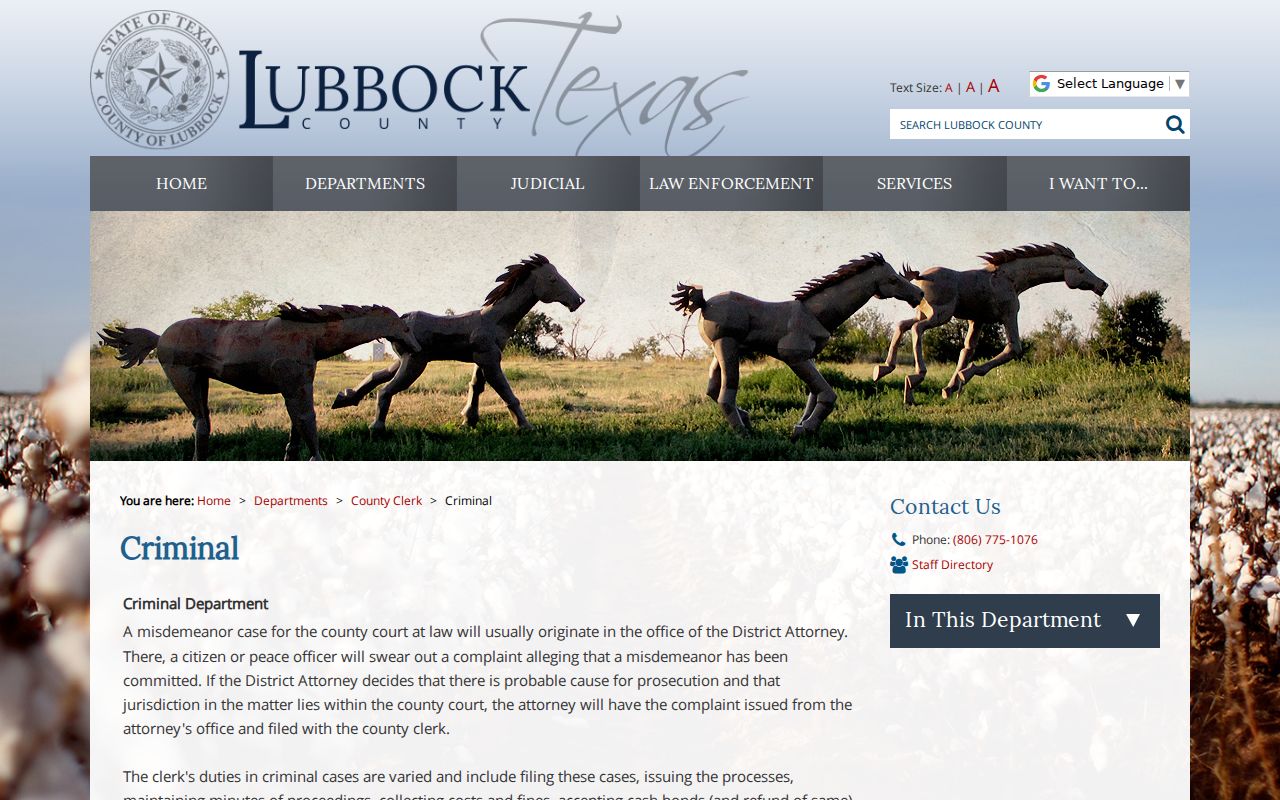
The County Clerk image reinforces why the case number must be found before a mailed Lubbock County criminal court copy order is prepared.
An expedited prepaid return envelope is allowed, but the county will not pay a carrier pickup fee. Online credit-card copy orders add the vendor charge of $2.50 or 2.95 percent, whichever is greater. Requests received after 10 a.m. mail the next business day. These terms belong to County Clerk misdemeanor copies, not every Lubbock County court service.
Case Record Access & Restrictions
Texas court case files are not governed by the Texas Public Information Act in the same way as executive-agency records. Texas court access guidance explains that Rule of Judicial Administration 12 applies to administrative judicial records, not documents filed in an adjudicative case. Filed case access instead rests on court law, rules, and the clerk's role as custodian.
Public access still has limits. Juvenile files use a separate confidential framework. Full Social Security numbers, account data, protected birth dates, minor identities, medical facts, and protected victim information may be redacted. Expunged, nondisclosed, sealed, or court-restricted material may not appear in an ordinary Lubbock County criminal case search. Ask the clerk whether the problem is venue, archive coverage, remote-image policy, or lawful restriction.
Access point: Government Code Chapter 552 governs public-information requests to agencies, but it does not turn the judicial case file into a TPIA record.
Note: DA eDiscovery is separate from the public portal and is not a route for browsing Lubbock County criminal court files.